Thursday, October 10, 2013

Dr Wayne Dyer ~ You Are Not Your Ego


monkeykeiths monkeykeiths


*****************************************************

Seven Steps for Overcoming Ego’s Hold on You

Here are seven suggestions to help you transcend ingrained ideas of self-importance. All of these are designed to help prevent you from falsely identifying with the self-important ego.
1. Stop being offended.
The behavior of others isn’t a reason to be immobilized. That which offends you only weakens you. If you’re looking for occasions to be offended, you’ll find them at every turn. This is your ego at work convincing you that the world shouldn't be the way it is. But you can become an appreciator of life and match up with the universal Spirit of Creation. You can’t reach the power of intention by being offended. By all means, act to eradicate the horrors of the world, which emanate from massive ego identification, but stay in peace. As A Course in Miracles reminds us: Peace is of God, you who are part of God are not at home except in his peace. Being is of God, you who are part of God are not at home except in his peace. Being offended creates the same destructive energy that offended you in the first place and leads to attack, counterattack, and war.
2. Let go of your need to win.
Ego loves to divide us up into winners and losers. The pursuit of winning is a surefire means to avoid conscious contact with intention. Why? Because ultimately, winning is impossible all of the time. Someone out there will be faster, luckier, younger, stronger, and smarter-and back you’ll go to feeling worthless and insignificant.
You’re not your winnings or your victories. You may enjoy competing, and have fun in a world where winning is everything, but you don’t have to be there in your thoughts. There are no losers in a world where we all share the same energy source. All you can say on a given day is that you performed at a certain level in comparison to the levels of others on that day. But today is another day, with other competitors and new circumstances to consider. You’re still the infinite presence in a body that’s another day (or decade) older. Let go of needing to win by not agreeing that the opposite of winning is losing. That’s ego’s fear. If your body isn’t performing in a winning fashion on this day, it simply doesn’t matter when you aren’t identifying exclusively with your ego. Be the observer, noticing and enjoying it all without needing to win a trophy. Be at peace, and match up with the energy of intention. And ironically, although you’ll hardly notice it, more of those victories will show up in your life as you pursue them less.
3. Let go of your need to be right.
Ego is the source of a lot of conflict and dissension because it pushes you in the direction of making other people wrong. When you’re hostile, you’ve disconnected from the power of intention. The creative Spirit is kind, loving, and receptive; and free of anger, resentment, or bitterness. Letting go of your need to be right in your discussions and relationships is like saying to ego, I’m not a slave to you. I want to embrace kindness, and I reject your need to be right. In fact, I’m going to offer this person a chance to feel better by saying that she’s right, and thank her for pointing me in the direction of truth.
When you let go of the need to be right, you’re able to strengthen your connection to the power of intention. But keep in mind that ego is a determined combatant. I’ve seen people end otherwise beautiful relationships by sticking to their need to be right. I urge you to let go of this ego-driven need to be right by stopping yourself in the middle of an argument and asking yourself, Do I want to be right or be happy? When you choose the happy, loving, spiritual mood, your connection to intention is strengthened. These moments ultimately expand your new connection to the power of intention. The universal Source will begin to collaborate with you in creating the life you were intended to live.


Read More Here


Enhanced by Zemanta

Tuesday, October 1, 2013

How Emotional Intelligence Can Make You Happy And Successful

Google's 'Jolly Good Fellow' On The Power Of Emotional Intelligence

Posted: 09/29/2013 8:48 am EDT  |  Updated: 09/30/2013 4:04 pm EDT
emotional intelligence

When Google engineer-turned-mindfulness expert Chade-Meng Tan gives a talk in front of a group of Silicon Valley developers and executives, he often starts with a simple exercise.
“Imagine two human beings. Don’t say anything, don’t do anything, just wish for those two human beings to be happy. That’s all.”
During one recent talk, he gave the group a homework assignment: Perform the exercise the next day at work, spending 10 seconds each hour randomly choosing two people and silently wishing for them to be happy. The following morning, Tan received an email from an employee who attended the workshop that read, “I hate my job. I hate coming to work every day. But yesterday I tried your suggestion and it was my happiest day in seven years.”
It’s not the first time that Tan -- who Wired recently dubbed an "Enlightenment engineer" -- has seen emotional intelligence exercises transform an employee’s work and life. As Google’s resident “Jolly Good Fellow,” Tan developed Search Inside Yourself (SIY) program, a mindfulness-based emotional intelligence training program. Tan's philosophy is that cultivating emotional intelligence through mindfulness training and meditation can help an individual reach a state of inner peace, the essential foundation of happiness, success and compassion.
More than 1,000 Google employees have gone through the SIY curriculum, according to Wired, the principles of which are outlined in Tan's New York Times bestseller, “Search Inside Yourself: The Unexpected Path To Achieving Success, Happiness (And World Peace)". The program focuses on building up the five emotional intelligence domains of self-awareness, self-regulation, motivation, empathy and social skills, primarily through meditation and mindfulness training, which aims to improve one's focus and attention on the present moment.
The benefits of emotional intelligence in the workplace are well-documented, from career success to improved relationships to better leadership -- and Tan says getting Silicon Valley interested in a meditation program to train employees in emotional intelligence wasn't difficult.

chade meng tan
"Everybody already knows, emotional intelligence is good for my career, it's good for my team, it's good for my profits," Tan tells the Huffington Post. "It comes pre-marketed, so all I had to do is create a curriculum for emotional intelligence that helps people succeed, with goodness and world-peace as the unavoidable side-effects."
Here are four ways that you can cultivate emotional intelligence -- and revolutionize your work, relationships and happiness.
Meditate.
meditation office
Tan outlines three major steps to developing emotional intelligence: Training attention ("the ability to bring the mind to a state that's calm and clear, and to do it on demand," he explains), self-awareness, and social intelligence. The first step is building an individual's powers of attention through meditation.
Tan is convinced that much like improving physical fitness, improving "mental fitness" through meditation and mindfulness practices can improve nearly every aspect of your life, from work to family life to physical health.
"There are some things in life where if you improve one thing, everything else in life is improved... If you improve physical fitness, it improves your home life, success, wellness, everything," says Tan. "The same is true for meditation, because meditation is in fact mental and emotional fitness. If you are fit mentally and emotionally, every aspect of your life improves."
Research has confimed that mindfulness contributes to emotional well-being, in addition to improving memory and attention. A 2013 University of Utah study found that individuals with mindful personality traits (such as self-awareness and attentiveness) exhibited more stable emotional patterns and reported feeling more in control of their moods and actions. Brown University research also found that mindfulness meditation could improve an individual's control over brain processing of pain and emotions.
Cultivate compassion.
Meditation is also the primary vehicle for cultivating compassion: A recent Harvard University study found that individuals who underwent eight weeks of meditation training were significantly more likely to help others in need than those who hadn't gone through the meditation training.
Neuroscientists have even seen that meditating on compassion can create an empathetic state in the brain. When Tibetan Buddhist monks were asked to meditate on "unconditional loving-kindness and compassion" in a 2006 study, the researchers measured brain activity in the left prefrontal cortex, which is associated with positive emotions, that was 30 times stronger than the activity among a control group of college students who didn't meditate, Wired reported. The researchers theorized that empathy may be something one can cultivated by "exercising" the brain through loving-kindness meditation.


Read More Here


*************************************************

Ommmm! How Silicon Valley values meditation


Published: Friday, 20 Sep 2013 | 2:54 PM ET

 photo siliconvalleyszenmaster_zps1a4d5793.jpg
Google is going Zen.
Silicon Valley is well known for its lucrative employee perks, but now companies are offering meditation and mindfulness courses to employees and there's a long waiting list to attend. Google's "Search Inside Yourself" course has been taken by more than 1,000 employees and currently has more than 400 on the waiting list. It's designed to teach people to manage their emotions, which could ultimately make them more productive and creative thinkers.
The program was created by Chade-Meng Tan, who was employee #107 at Google. His official job title is "Jolly Good Fellow," which is a drastic change since his days at Google starting out as a software engineer.
He's also come out with a book, "Search Inside Yourself: The Unexpected Path to Achieving Success, Happiness (And World Peace)" which has been ranked a New York Times Best Seller.
"Meng" came to the New York Stock Exchange where he joined CNBC's Tyler Mathisen and Kenny Polcari, director of NYSE floor operations at O'Neil Securities, to give some tips on quick ways to de-stress.


Read More and Watch Video Here


*************************************************
Enhanced by Zemanta

The Committee of the Mind

 --by Thanissaro Bhikku (Sep 30, 2013)

There are many different ideas of “you” in your mind, each with its own agenda. Each of these “you's” is a member of the committee of the mind. This is why the mind is less like a single mind and more like an unruly throng of people: lots of different voices, with lots of different opinions about what you should do. Some members of the committee are open and honest about the assumptions underlying their central desires. Others are more obscure and devious. This is because each committee member is like a politician, with its own supporters and strategies for satisfying their desires. [...]

One of the purposes of meditation is to bring these dealings out into the open, so that you can bring more order to the committee—so that your desires for happiness work less at cross purposes, and more in harmony as you realize that they don’t always have to be in conflict. Thinking of these desires as a committee also helps you realize that when the practice of meditation goes against some of your desires, it doesn’t go against all of your desires. You’re not being starved. You don’t have to identify with the desires being thwarted through meditation, because you have other, more skillful desires to identify with. The choice is yours. You can also use the more skillful members of the committee to train the less skillful ones so that they stop sabotaging your efforts to find a genuine happiness.   Always remember that genuine happiness is possible, and the mind can train itself to find that happiness. […]
Enhanced by Zemanta

Saturday, September 28, 2013

Highly effective and happy people share many of the same perspectives and beliefs and they act on those beliefs. Here are 15 of them......

                                                                            Rainbow Spirit

                                                        D. Sharon Pruitt Pink Sherbet Photography
*******************************************************************************************

 Prevent Disease .com

September 23, 2013 by TARA LASERNA
Regardless of industry, profession, town, city or nation, highly effective and happy people share many of the same perspectives and beliefs and they act on those beliefs.
1. Time doesn't fill me. I fill time.
The average person who is given two weeks to complete a task will instinctively adjust his or her effort so it actually takes two weeks. Average people allow time to impose its will on them; remarkable people impose their will on their time and allow fluidity. They don't stress about time and because their perception is more fluid, time does not become their focus and tasks become more manageable.
2. I understand balance.
They know that the terms money and success are not interchangeable. They understand that people who are successful on a financial level only, are not successful at all. They have an off switch. They know how to relax, enjoy what they have in their life and to have fun. Their career is not their identity, it’s their job. It’s not who they are, it’s what they do. Unfortunately we live in a society which teaches that money equals success. Like many other things, money is a tool. It’s certainly not a bad thing but ultimately, it’s just another resource. Unfortunately, too many people worship it.
3. The people around me are the people I chose.
Choose the people you want around you and don't let people you don't want around you choose you. If the people around you make you unhappy it's not their fault. It's your fault. They're in your professional or personal life because you drew them to you--and you let them remain. Kind people like to associate with kind people.  It's about aligning yourself with like-minded people. They understand the importance of being part of a team. They create win-win relationships. A mean boss will only attract people he or she can control where a boss that empowers will attract people that love to be empowered. The former is a disempowering relationship while the latter is an empowering relationship. Know the difference.
4. I'm never bored and I never complain.
Complainers, whiners and those who refuse to take complete responsibility for their actions and outcomes (or lack thereof) often meet their demise in this respect. They bore easily because they are too busy pretending life has to meet their expectations instead of them reaching out and being passionate about every experience. It's about being busy, productive and proactive. While most are laying on the couch, planning, over-thinking, sitting on their hands and generally going around in circles, effective people are out there getting the job done. When you are living the life you choose, complaining, whining and boredom don't exist.
5. I have never paid my dues.
Dues aren't paid, past tense. Dues get paid, each and every day. The only real measure of your value is the tangible contribution you make on a daily basis. No job is ever too menial, no task ever too unskilled or boring. Remarkably effective people never feel entitled--except to the fruits of their labor.
6. I ask the right questions.
They consciously and methodically create their own success by asking the questions that will make them more productive, creative, with a more positive mindset and empowering emotional state.
7. Failure is something I accomplish; it doesn't just happen to me.
Occasionally something completely outside your control will cause you to fail. Most of the time though, it's you. And that's okay. Every successful person has failed. Numerous times. Most of them have failed a lot more often than you. But they found lessons in failures, not problems or misery. That's why they learned how to be effective. Embrace every failure: Own it, learn from it, and take full responsibility for making sure that next time, things will turn out differently.
8. Clarity, innovation and focus.
They have clarity and certainty about what they want (and don’t want) for their life. They actually visualize and plan their best reality while others are merely spectators of life. They innovate rather than imitate. They don’t procrastinate and they don’t spend their life waiting for the ‘right time’. The focus and apply themselves.
9. Volunteers always win.
Whenever you raise your hand you wind up being asked to do more. That's great. Doing more is an opportunity: to learn, to impress, to gain skills, to build new relationships--to do something more than you would otherwise been able to do. Success is based on action. The more you volunteer, the more you get to act. Effective people step forward to create opportunities. Remarkably effective people sprint forward. They look for and find opportunities where others see nothing.
10. Not only good communicators, but the best communicators
They are good communicators and they consciously work at it. They are more effective than most at managing their emotions when communicating with others and they are not slaves to these emotions. Ego does not rule their lives. They have identified their core values (what is important to them) and they do their best to live a life which is reflective of those values when speaking with others. Their ethical behavior is sound.
11. I address the solutions, not the problems.
People have a tendency of creating more problems than solutions which hinders their effectiveness. They can only see obstacles where as others just have a way of seeing past them and getting right to the solutions that no longer make a problem....well, a problem anymore. They are solutions seekers, not problem enablers.
12. I am humble and happy to admit my own mistakes.
They apologize when they must. They forgive and they are confident in their ability, but not arrogant. They are happy to learn from others and see other perspectives than their own. They are happy to make others look good rather than seek their own personal glory.
13. I set higher standards for myself.
This in turn produces greater commitment, more momentum, a better work ethic and of course, better results. They don’t rationalize failure. While many are talking about their age, their sore back, their lack of time, their poor genetics, their ‘bad luck’, their nasty boss and their lack of opportunities (all good reasons to fail), they are finding a way to succeed despite all their challenges.
14. I finish what I start.
While so many spend their life starting things that they never finish, effective people get the job done – even when the excitement and the novelty have worn off. Even when it ain’t fun.
15. Being multi-dimensional, amazing, and wonderfully complex
They realize that not only are they physical and psychological beings, but emotional and spiritual creatures as well. They consciously work at being healthy and productive on all levels inside and out. They don’t hang out with toxic people and they don’t invest time or emotional energy into things which they have no control of. They do what they can do advance themselves to the best of their ability and never look back, even for a second, because the past is no longer within their control. They plan for the future in harmony with their present state of mind and don't overplan or overanalyze because they understand that thought processes are constantly evolving and forever growing.
Tara Laserna is a Reiki master, energy healer, meditation and wellness coach.
Enhanced by Zemanta

Thursday, August 29, 2013

Chris Abani: On humanity


TEDtalksDirector TEDtalksDirector


Uploaded on Jul 22, 2008
Chris Abani tells stories of people: people standing up to soldiers, people showing compassion, people being human or reclaiming their humanity. And according to this critically-acclaimed Nigerian poet and novelist, these stories are a way of imparting something called "ubuntu." Meaning, the only way for me to be human is for you to reflect my humanity back at me. "...the world is never saved in grand, messianic gestures but in the simple accumulation of gentle, soft, almost invisible acts of compassion; everyday acts of compassion..." -
Chris Abani tells stories of people: people standing up to soldiers, people showing compassion, people being human or reclaiming their humanity. And according to this critically-acclaimed Nigerian poet and novelist, these stories are a way of imparting something called "ubuntu." Meaning, the only way for me to be human is for you to reflect my humanity back at me. "...the world is never saved in grand, messianic gestures but in the simple accumulation of gentle, soft, almost invisible acts of compassion; everyday acts of compassion..." - See more at: http://www.karmatube.org/videos.php?id=1301#sthash.LbeFbF2N.dpuf

Enhanced by Zemanta

Monday, August 26, 2013

A Call to Heart for World Leaders, White Buffalo Day 2013

Chief Arvol Looking Horse Speaks of White Buffalo Prophecy

knewways knewways


Uploaded on Aug 26, 2010
Chief Arvol Looking Horse, 19th generation Keeper of the Sacred White Buffalo Calf Pipe. The leader of the Lakota Dakota Nakota Oyate, the great Sioux nation, is a man with a vision.
A Great Urgency: To All World Religious and Spiritual Leaders
My Relatives,
Time has come to speak to the hearts of our Nations and their Leaders. I ask you this from the bottom of my heart, to come together from the Spirit of your Nations in prayer.
We, from the heart of Turtle Island, have a great message for the World; we are guided to speak from all the White Animals showing their sacred color, which have been signs for us to pray for the sacred life of all things.
The dangers we are faced with at this time are not of spirit, mistakes that we cannot afford to continue to make.
I asked, as Spiritual Leaders, that we join together, united in prayer with the whole of our Global Communities. My concern is these serious issues will continue to worsen, as a domino effect that our Ancestors have warned us of in their Prophecies.
I know in my heart there are millions of people that feel our united prayers for the sake of our Grandmother Earth are long overdue. I believe we as Spiritual people must gather ourselves and focus our thoughts and prayers to allow the healing of the many wounds that have been inflicted on the Earth.
As we honor the Cycle of Life, let us call for Prayer circles globally to assist in healing Grandmother Earth (our Unc¹I Maka), and that we may also seek to live in harmony, as we make the choice to change the destructive path we are on.
As we pray, we will fully understand that we are all connected. And that what we create can have lasting effects on all life.
So let us unite spiritually, All Nations, All Faiths, One Prayer. Along with this immediate effort, I also ask to please remember World Peace and Prayer Day/ Honoring Sacred Sites day. Whether it is a natural site, a temple, a church, a synagogue or just your own sacred space, let us make a prayer for all life, for good decision making by our Nations, for our children¹s future and well-being, and the generations to come.
Onipikte (that we shall live),
Chief Arvol Looking Horse sees a great danger threatening "Grandmother Earth" and a great hope for restoring her wholeness. So he is calling all nations to prayer of any kind in an effort to return the planet to balance, the people to spirit. I asked him why this path is the right path to take. "A man or a woman without spirit is very dangerous," Looking Horse explained in a recent phone interview. According to this Sioux chief, the absence of spirit is causing suffering everywhere. "We are in a time of survival," he said. "But we don't want to believe it because we have forgotten our spirits. We have forgotten that Grandmother Earth has a spirit." Disconnected souls are hurting others without even knowing they are hurting others." Those being hurt include animals, trees and waterways. The Sioux have an inclusive worldview, but it was not shared by the transplanted Europeans who undertook genocide on Indian land, culminating in the Wounded Knee massacre of 1890. That final brutality broke the "hoop" binding Indians together; however, Sioux prophecy foretold that in a hundred years the people would be reunited. Although surviving tribe members and their descendants were stripped of religious freedoms (returned to them only 32 year ago by the U.S. government), the rituals were kept and the prophecy not forgotten. So the Sioux nations set out on horseback to "mend the broken hoop" of their nation in 1986 at a sacred site known to non-Indians as Devils Tower or the Great Horn Butte; their ritual went on for four years and concluded in 1990, 100 years after Wounded Knee. During the course of that long ritual, Looking Horse was surprised by a vision that came to him of peace and unity that included not only the Indian nations but all the nations of the world, each gathering with ritual plants around sacred fires on every continent. The Sioux chief felt called to oversee a much broader mending. But who was going to listen even to the chief of a people largely ignored in the country where they lived? "It's everyday life for us that we hold Grandmother Earth sacred, we hold the trees and the plants, everything has a spirit. We need people to be really respectful for each other. The Great Spirit put us here all together. If we're going to survive, we need to have spirit and compassion. We're asking people to go to their sacred places or sacred spaces to pray." "Sioux Indian chief calls all nations to action on June 21" by Juliane Poirier
Music gifted by Tony Gerber
jacob devaney
to me


***********************************************

A Call to Heart for World Leaders, White Buffalo Day 2013

Posted: 08/26/2013 4:42 pm


I often wonder if those making decisions at the upper levels of government have a heart but even if they forget to listen to it, it is there. With so much distraction happening in the head and constant external pressure, listening to the heart isn't always so easy to do. It requires taking a moment to stop, breathe, listen within, and the willingness to let go of the demands placed on us by our minds and others. Accessing the wisdom of the heart almost always involves clearing the mind and this year for the annual White Buffalo Day Celebration we are reminded to step back and consider the larger picture of our roles on this planet, our impact, and our potential to come together and make much needed changes. Clearly this can only happen if our political world leaders are listening as well. What will it take to call them back to the heart?
2013-08-26-goat2.jpg
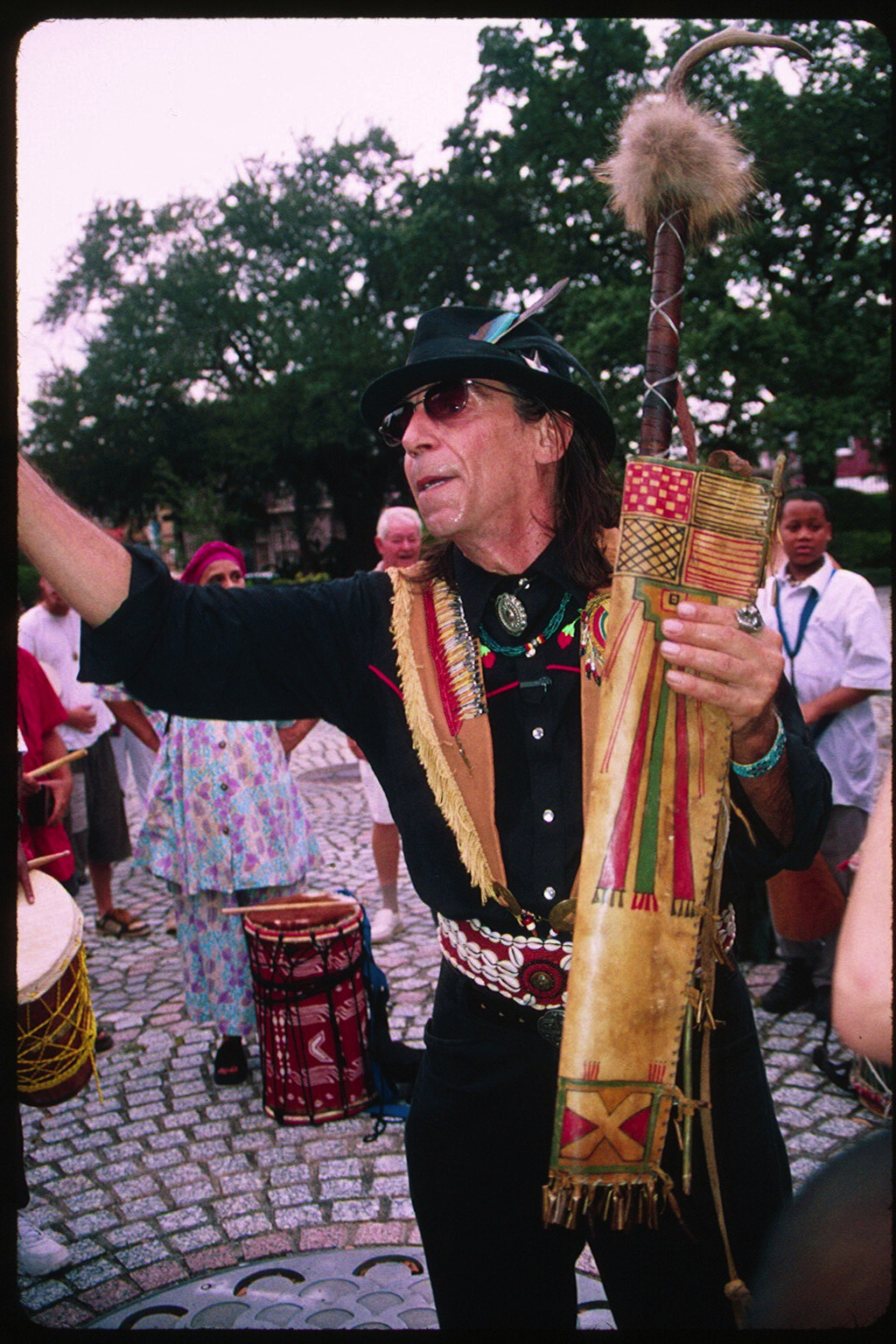
Goat Carson at White Buffalo Day 2005. Photo Courtesy of Jeffrey Ehrenreich
White Buffalo is a story passed down for 19 generations in The Lakota Tradition with a beautiful vision of harmony between nations and healing for the land. Sounds like something we could really use right about now doesn't it? The story speaks of a White Buffalo being born to send a warning to the people, but to also symbolize a great potential for change if the people choose to wake up and return to living in a harmonious way with Mother Earth. Coinciding with a pipe ceremony in Congo Square in New Orleans in 1994, a White Buffalo was born in Janesville, Wisconsin and this was the beginning of White Buffalo Day.
On August 27th every year around the world and in Congo Square, New Orleans people gather to consider the implications of this powerful idea. Congo Square is believed to be one of the birth-places of jazz and blues, a place where Native Americans and African Slaves traded, danced, and drummed freely thanks to progressive French Plantation Owners in the area. Nestled in the heart of The Treme Neighborhood made famous by the HBO series of the same name, Congo Square is also known as Louis Armstrong Park. New Orleans has a rich history of cultural cross-pollination in art, food, and its music has brought people together joyously for decades so it is the perfect place for the vision of The White Buffalo to be honored and celebrated each year.
David "Goat" Carson, a native elder, reverend, poet, musician, oral-historian, and community organizer in New Orleans has hosted The White Buffalo Day Celebration for 20 years. Carson is most known for his Grammy-Awarded songs performed by Dr. John and his thought-provoking social commentary masked in works of fiction like Shallow Graves. Respected Black Indian Chief, Allison "Tootie" Montana, was also central to the vision of White Buffalo Day in New Orleans. Musicians like Cyril Neville, known for his soulful musical expressions for social justice, along with his wife Gaynielle have also participated in making White Buffalo Day special over the years. With a growing list of New Orleans cultural dignitaries and artists, the event has continued to be at the spiritual heart of the city, attracting people from all ethnic backgrounds to share a worthy vision.


Read More Here
Enhanced by Zemanta