Thursday, August 29, 2013

Chris Abani: On humanity


TEDtalksDirector TEDtalksDirector


Uploaded on Jul 22, 2008
Chris Abani tells stories of people: people standing up to soldiers, people showing compassion, people being human or reclaiming their humanity. And according to this critically-acclaimed Nigerian poet and novelist, these stories are a way of imparting something called "ubuntu." Meaning, the only way for me to be human is for you to reflect my humanity back at me. "...the world is never saved in grand, messianic gestures but in the simple accumulation of gentle, soft, almost invisible acts of compassion; everyday acts of compassion..." -
Chris Abani tells stories of people: people standing up to soldiers, people showing compassion, people being human or reclaiming their humanity. And according to this critically-acclaimed Nigerian poet and novelist, these stories are a way of imparting something called "ubuntu." Meaning, the only way for me to be human is for you to reflect my humanity back at me. "...the world is never saved in grand, messianic gestures but in the simple accumulation of gentle, soft, almost invisible acts of compassion; everyday acts of compassion..." - See more at: http://www.karmatube.org/videos.php?id=1301#sthash.LbeFbF2N.dpuf

Enhanced by Zemanta

Monday, August 26, 2013

A Call to Heart for World Leaders, White Buffalo Day 2013

Chief Arvol Looking Horse Speaks of White Buffalo Prophecy

knewways knewways


Uploaded on Aug 26, 2010
Chief Arvol Looking Horse, 19th generation Keeper of the Sacred White Buffalo Calf Pipe. The leader of the Lakota Dakota Nakota Oyate, the great Sioux nation, is a man with a vision.
A Great Urgency: To All World Religious and Spiritual Leaders
My Relatives,
Time has come to speak to the hearts of our Nations and their Leaders. I ask you this from the bottom of my heart, to come together from the Spirit of your Nations in prayer.
We, from the heart of Turtle Island, have a great message for the World; we are guided to speak from all the White Animals showing their sacred color, which have been signs for us to pray for the sacred life of all things.
The dangers we are faced with at this time are not of spirit, mistakes that we cannot afford to continue to make.
I asked, as Spiritual Leaders, that we join together, united in prayer with the whole of our Global Communities. My concern is these serious issues will continue to worsen, as a domino effect that our Ancestors have warned us of in their Prophecies.
I know in my heart there are millions of people that feel our united prayers for the sake of our Grandmother Earth are long overdue. I believe we as Spiritual people must gather ourselves and focus our thoughts and prayers to allow the healing of the many wounds that have been inflicted on the Earth.
As we honor the Cycle of Life, let us call for Prayer circles globally to assist in healing Grandmother Earth (our Unc¹I Maka), and that we may also seek to live in harmony, as we make the choice to change the destructive path we are on.
As we pray, we will fully understand that we are all connected. And that what we create can have lasting effects on all life.
So let us unite spiritually, All Nations, All Faiths, One Prayer. Along with this immediate effort, I also ask to please remember World Peace and Prayer Day/ Honoring Sacred Sites day. Whether it is a natural site, a temple, a church, a synagogue or just your own sacred space, let us make a prayer for all life, for good decision making by our Nations, for our children¹s future and well-being, and the generations to come.
Onipikte (that we shall live),
Chief Arvol Looking Horse sees a great danger threatening "Grandmother Earth" and a great hope for restoring her wholeness. So he is calling all nations to prayer of any kind in an effort to return the planet to balance, the people to spirit. I asked him why this path is the right path to take. "A man or a woman without spirit is very dangerous," Looking Horse explained in a recent phone interview. According to this Sioux chief, the absence of spirit is causing suffering everywhere. "We are in a time of survival," he said. "But we don't want to believe it because we have forgotten our spirits. We have forgotten that Grandmother Earth has a spirit." Disconnected souls are hurting others without even knowing they are hurting others." Those being hurt include animals, trees and waterways. The Sioux have an inclusive worldview, but it was not shared by the transplanted Europeans who undertook genocide on Indian land, culminating in the Wounded Knee massacre of 1890. That final brutality broke the "hoop" binding Indians together; however, Sioux prophecy foretold that in a hundred years the people would be reunited. Although surviving tribe members and their descendants were stripped of religious freedoms (returned to them only 32 year ago by the U.S. government), the rituals were kept and the prophecy not forgotten. So the Sioux nations set out on horseback to "mend the broken hoop" of their nation in 1986 at a sacred site known to non-Indians as Devils Tower or the Great Horn Butte; their ritual went on for four years and concluded in 1990, 100 years after Wounded Knee. During the course of that long ritual, Looking Horse was surprised by a vision that came to him of peace and unity that included not only the Indian nations but all the nations of the world, each gathering with ritual plants around sacred fires on every continent. The Sioux chief felt called to oversee a much broader mending. But who was going to listen even to the chief of a people largely ignored in the country where they lived? "It's everyday life for us that we hold Grandmother Earth sacred, we hold the trees and the plants, everything has a spirit. We need people to be really respectful for each other. The Great Spirit put us here all together. If we're going to survive, we need to have spirit and compassion. We're asking people to go to their sacred places or sacred spaces to pray." "Sioux Indian chief calls all nations to action on June 21" by Juliane Poirier
Music gifted by Tony Gerber
jacob devaney
to me


***********************************************

A Call to Heart for World Leaders, White Buffalo Day 2013

Posted: 08/26/2013 4:42 pm


I often wonder if those making decisions at the upper levels of government have a heart but even if they forget to listen to it, it is there. With so much distraction happening in the head and constant external pressure, listening to the heart isn't always so easy to do. It requires taking a moment to stop, breathe, listen within, and the willingness to let go of the demands placed on us by our minds and others. Accessing the wisdom of the heart almost always involves clearing the mind and this year for the annual White Buffalo Day Celebration we are reminded to step back and consider the larger picture of our roles on this planet, our impact, and our potential to come together and make much needed changes. Clearly this can only happen if our political world leaders are listening as well. What will it take to call them back to the heart?
2013-08-26-goat2.jpg
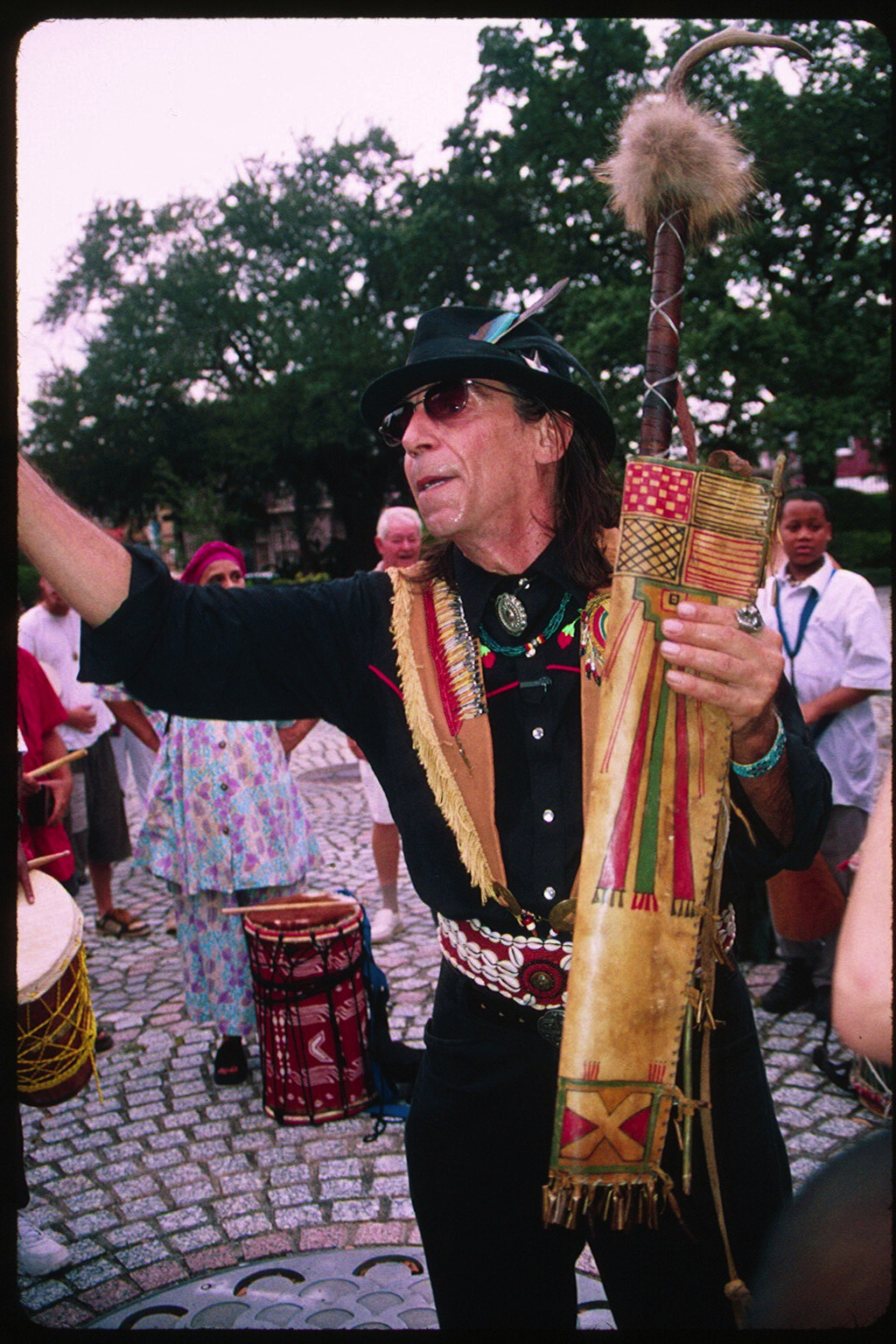
Goat Carson at White Buffalo Day 2005. Photo Courtesy of Jeffrey Ehrenreich
White Buffalo is a story passed down for 19 generations in The Lakota Tradition with a beautiful vision of harmony between nations and healing for the land. Sounds like something we could really use right about now doesn't it? The story speaks of a White Buffalo being born to send a warning to the people, but to also symbolize a great potential for change if the people choose to wake up and return to living in a harmonious way with Mother Earth. Coinciding with a pipe ceremony in Congo Square in New Orleans in 1994, a White Buffalo was born in Janesville, Wisconsin and this was the beginning of White Buffalo Day.
On August 27th every year around the world and in Congo Square, New Orleans people gather to consider the implications of this powerful idea. Congo Square is believed to be one of the birth-places of jazz and blues, a place where Native Americans and African Slaves traded, danced, and drummed freely thanks to progressive French Plantation Owners in the area. Nestled in the heart of The Treme Neighborhood made famous by the HBO series of the same name, Congo Square is also known as Louis Armstrong Park. New Orleans has a rich history of cultural cross-pollination in art, food, and its music has brought people together joyously for decades so it is the perfect place for the vision of The White Buffalo to be honored and celebrated each year.
David "Goat" Carson, a native elder, reverend, poet, musician, oral-historian, and community organizer in New Orleans has hosted The White Buffalo Day Celebration for 20 years. Carson is most known for his Grammy-Awarded songs performed by Dr. John and his thought-provoking social commentary masked in works of fiction like Shallow Graves. Respected Black Indian Chief, Allison "Tootie" Montana, was also central to the vision of White Buffalo Day in New Orleans. Musicians like Cyril Neville, known for his soulful musical expressions for social justice, along with his wife Gaynielle have also participated in making White Buffalo Day special over the years. With a growing list of New Orleans cultural dignitaries and artists, the event has continued to be at the spiritual heart of the city, attracting people from all ethnic backgrounds to share a worthy vision.


Read More Here
Enhanced by Zemanta

Monday, July 29, 2013

We are created by Universal Love with the intention of spreading Love and making the lives of others a masterpiece.

Align Yourself with Universal Love

By Michael Cupo.
We make our life what it is, but we are not the creator of it. We are created by Universal Love with the intention of spreading Love and making the lives of others a masterpiece.
Paint a masterpiece of LoveThink of your life as a giant canvas. Everyday you have an opportunity to paint a new picture. The more your mind is settled, the more in touch you become with your creative self. You can make each day a masterpiece inspired by love, or you can just create an ordinary day of existence. There is nothing wrong in this, it just that life isn’t lived to the fullest. It is still beautiful in its essence, but its beauty is not known because of unconsciousness. You are not the creator of life, but you create the way the life you are given is lived.
Although we don’t create life itself (only the Universe can do that), we are responsible for how it is lived. Our origin is not of our doing. No matter what humans do, we will never be as miraculous as our creator.


Read More Here

Gratitude

 photo GRATITUDEWhiteBeachwithblackeuropeanborderwikimediacommonsAuthorEsterInbar_zpsfbe2e5f8.jpg
Copyright :  Desert Rose Creations / Family Survival Protocol  2013
Enhanced by Zemanta

Oneness is more than a concept. It's an experience and a way of living.

Inspiration Archives: Dr. Jonathan Ellerby


I want humanity to know oneness. It sounds complicated at first, but it is simple and will change your life forever. It did for me.
Oneness is more than a concept. It's an experience and a way of living.
In every culture throughout time there have been saints, mystics, sages, shamans and prophets who have come to the same conclusion: all things in this world are deeply interconnected and ultimately are only diverse expressions of the one original source energy.
This was the essential experience and conviction of most of the worlds' religious founding leaders. They called the Oneness of life different things: God, Allah, Hashem, The Great Mystery and so on, but the idea of oneness is universal. Oneness means we are each united with all of life.
Oneness is not just a spiritual or religious idea. It is now a clear scientific principle. Einstein died trying to prove the unified field theory, a belief that all life and matter are united by an underlying energy or consciousness.
The great quantum physicists David Bohm, Arthur Eddington, Max Planck and many others were convinced that at the very deepest (smallest) level of all things was energy. Deep within each cell, each molecule, each atom and nucleus, breathes an energy so subtle and yet so essential it could be called "spirit."


Read More Here


Enhanced by Zemanta

Saturday, July 27, 2013

Gandhi’s Top 10 Fundamentals for Changing the World

The Positivity Blog


by Henrik Edberg

Gandhi’s Top 10 Fundamentals for Changing the World“You must not lose faith in humanity. Humanity is an ocean; if a few drops of the ocean are dirty, the ocean does not become dirty.”
“The difference between what we do and what we are capable of doing would suffice to solve most of the world’s problem.”
“If I had no sense of humor, I would long ago have committed suicide.”
Mahatma Gandhi needs no long introduction. Everyone knows about the man who lead the Indian people to independence from British rule in 1947.
So let’s just move on to some of my favourite tips from Mahatma Gandhi.

1. Change yourself.

“You must be the change you want to see in the world.”
“As human beings, our greatness lies not so much in being able to remake the world – that is the myth of the atomic age – as in being able to remake ourselves.”
If you change yourself you will change your world. If you change how you think then you will change how you feel and what actions you take. And so the world around you will change. Not only because you are now viewing your environment through new lenses of thoughts and emotions but also because the change within can allow you to take action in ways you wouldn’t have – or maybe even have thought about – while stuck in your old thought patterns.
And the problem with changing your outer world without changing yourself is that you will still be you when you reach that change you have strived for. You will still have your flaws, anger, negativity, self-sabotaging tendencies etc. intact.
And so in this new situation you will still not find what you hoped for since your mind is still seeping with that negative stuff. And if you get more without having some insight into and distance from your ego it may grow more powerful. Since your ego loves to divide things, to find enemies and to create separation it may start to try to create even more problems and conflicts in your life and world.

2. You are in control.

“Nobody can hurt me without my permission.”
What you feel and how you react to something is always up to you. There may be a “normal” or a common way to react to different things. But that’s mostly just all it is.
You can choose your own thoughts, reactions and emotions to pretty much everything. You don’t have to freak out, overreact of even react in a negative way. Perhaps not every time or instantly. Sometimes a knee-jerk reaction just goes off. Or an old thought habit kicks in.
And as you realize that no-one outside of yourself can actually control how you feel you can start to incorporate this thinking into your daily life and develop it as a thought habit. A habit that you can grow stronger and stronger over time. Doing this makes life a whole lot easier and more pleasurable.

3. Forgive and let it go.

“The weak can never forgive. Forgiveness is the attribute of the strong.”
“An eye for eye only ends up making the whole world blind.”
Fighting evil with evil won’t help anyone. And as said in the previous tip, you always choose how to react to something. When you can incorporate such a thought habit more and more into your life then you can react in a way that is more useful to you and others.
You realize that forgiving and letting go of the past will do you and the people in your world a great service. And spending your time in some negative memory won’t help you after you have learned the lessons you can learn from that experience. You’ll probably just cause yourself more suffering and paralyze yourself from taking action in this present moment.
If you don’t forgive then you let the past and another person to control how you feel. By forgiving you release yourself from those bonds. And then you can focus totally on, for instance, the next point.

4. Without action you aren’t going anywhere.

“An ounce of practice is worth more than tons of preaching.”
Without taking action very little will be done. However, taking action can be hard and difficult. There can be much inner resistance.
And so you may resort to preaching, as Gandhi says. Or reading and studying endlessly. And feeling like you are moving forward. But getting little or no practical results in real life.
So, to really get where you want to go and to really understand yourself and your world you need to practice. Books can mostly just bring you knowledge. You have to take action and translate that knowledge into results and understanding.
You can check out a few effective tips to overcome this problem in How to Take More Action: 9 Powerful Tips. Or you can move on to the next point for more on the best tip for taking more action that I have found so far.

5. Take care of this moment.

“I do not want to foresee the future. I am concerned with taking care of the present. God has given me no control over the moment following.”
The best way that I have found to overcome the inner resistance that often stops us from taking action is to stay in the present as much as possible and to be accepting.
Why? Well, when you are in the present moment you don’t worry about the next moment that you can’t control anyway. And the resistance to action that comes from you imagining negative future consequences – or reflecting on past failures – of your actions loses its power. And so it becomes easier to both take action and to keep your focus on this moment and perform better.
Have a look at 8 Ways to Return to the Present Moment for tips on how quickly step into the now. And remember that reconnecting with and staying in the now is a mental habit – a sort of muscle – that you grow. Over time it becomes more powerful and makes it easier to slip into the present moment.


Read More Here


Enhanced by Zemanta

Friday, July 26, 2013

How to be Hopeful


 photo HopeisaWakingDream_zpsf5172a27.jpg

Copyright Desert Rose Creations / Family Survival Protocol   2013

**************************************************************************

2008 Commencement Address by Barbara Kingsolver

The following remarks by Barbara Kingsolver, titled "How to be Hopeful," were prepared for delivery at Duke's 2008 commencement ceremony May 11 at Wallace Wade Stadium.
Editor's Note: Barbara Kingsolver is a novelist, essayist, non-fiction and short-story writer. An audio version of her speech is available on iTunes.

Durham, NC - The very least you can do in your life is to figure out what you hope for. The most you can do is live inside that hope, running down its hallways, touching the walls on both sides.
Let me begin that way: with an invocation of your own best hopes, thrown like a handful of rice over this celebration. Congratulations, graduates. Congratulations, parents, on the best Mother's Day gift ever. Better than all those burnt-toast breakfasts: these, your children grown tall and competent, educated to within an inch of their lives.
What can I say to people who know almost everything? There was a time when I surely knew, because I'd just graduated from college myself, after writing down the sum of all human knowledge on exams and research papers. But that great pedagogical swilling-out must have depleted my reserves, because decades have passed and now I can't believe how much I don't know. Looking back, I can discern a kind of gaseous exchange in which I exuded cleverness and gradually absorbed better judgment. Wisdom is like frequent-flyer miles and scar tissue; if it does accumulate, that happens by accident while you're trying to do something else. And wisdom is what people will start wanting from you, after your last exam. I know it's true for writers - -- when people love a book, whatever they say about it, what they really mean is: it was wise. It helped explain their pickle. My favorites are the canny old codgers: Neruda, Garcia Marquez, Doris Lessing. Honestly, it is harrowing for me to try to teach 20-year-old students, who earnestly want to improve their writing. The best I can think to tell them is: Quit smoking, and observe posted speed limits. This will improve your odds of getting old enough to be wise.
If I stopped there, you might have heard my best offer. But I am charged with postponing your diploma for about 15 more minutes, so I'll proceed, with a caveat. The wisdom of each generation is necessarily new. This tends to dawn on us in revelatory moments, brought to us by our children. For example: My younger daughter is eleven. Every morning, she and I walk down the lane from our farm to the place where she meets the school bus. It's the best part of my day. We have great conversations. But a few weeks ago as we stood waiting in the dawn's early light, Lily was quietly looking me over, and finally said: "Mom, just so you know, the only reason I'm letting you wear that outfit is because of your age." The alleged outfit will not be described here; whatever you're imagining will perfectly suffice. (Especially if you're picturing "Project Runway" meets "Working with Livestock.") Now, I believe parents should uphold respect for adult authority, so I did what I had to do. I hid behind the barn when the bus came.
And then I walked back up the lane in my fly regalia, contemplating this new equation: "Because of your age." It's okay now to deck out and turn up as the village idiot. Hooray! I am old enough. How does this happen? Over a certain age, do you become invisible? There is considerable evidence for this in movies and television. But mainly, I think, you're not expected to know the rules. Everyone knows you're operating on software that hasn't been updated for a good while.
The world shifts under our feet. The rules change. Not the Bill of Rights, or the rules of tenting, but the big unspoken truths of a generation. Exhaled by culture, taken in like oxygen, we hold these truths to be self-evident: You get what you pay for. Success is everything. Work is what you do for money, and that's what counts. How could it be otherwise? And the converse of that last rule, of course, is that if you're not paid to do a thing, it can't be important. If a child writes a poem and proudly reads it, adults may wink and ask, "Think there's a lot of money in that?" You may also hear this when you declare a major in English. Being a good neighbor, raising children: the road to success is not paved with the likes of these. Some workplaces actually quantify your likelihood of being distracted by family or volunteerism. It's called your coefficient of Drag. The ideal number is zero. This is the Rule of Perfect Efficiency.
Now, the rule of "Success" has traditionally meant having boatloads of money. But we are not really supposed to put it in a boat. A house would the customary thing. Ideally it should be large, with a lot of bathrooms and so forth, but no more than four people. If two friends come over during approved visiting hours, the two children have to leave. The bathroom-to-resident ratio should at all times remain greater than one. I'm not making this up, I'm just observing, it's more or less my profession. As Yogi Berra told us, you can observe a lot just by watching. I see our dream-houses standing alone, the idealized life taking place in a kind of bubble. So you need another bubble, with rubber tires, to convey yourself to places you must visit, such as an office. If you're successful, it will be a large, empty-ish office you don't have to share. If you need anything, you can get it delivered. Play your cards right and you may never have to come face to face with another person. This is the Rule of Escalating Isolation.
And so we find ourselves in the chapter of history I would entitle: Isolation and Efficiency, and How They Came Around to Bite Us in the Backside. Because it's looking that way. We're a world at war, ravaged by disagreements, a bizarrely globalized people in which the extravagant excesses of one culture wash up as famine or flood on the shores of another. Even the architecture of our planet is collapsing under the weight of our efficient productivity. Our climate, our oceans, migratory paths, things we believed were independent of human affairs. Twenty years ago, climate scientists first told Congress that unlimited carbon emissions were building toward a disastrous instability. Congress said, we need to think about that. About ten years later, nations of the world wrote the Kyoto Protocol, a set of legally binding controls on our carbon emissions. The US said, we still need to think about it. Now we can watch as glaciers disappear, the lights of biodiversity go out, the oceans reverse their ancient orders. A few degrees looked so small on the thermometer. We are so good at measuring things and declaring them under control. How could our weather turn murderous, pummel our coasts and push new diseases like denge fever onto our doorsteps? It's an emergency on a scale we've never known. We've responded by following the rules we know: Efficiency, Isolation. We can't slow down our productivity and consumption, that's unthinkable. Can't we just go home and put a really big lock on the door?
Not this time. Our paradigm has met its match. The world will save itself, don't get me wrong. The term "fossil fuels" is not a metaphor or a simile. In the geological sense, it's over. The internal combustion engine is so 20th Century. Now we can either shift away from a carbon-based economy, or find another place to live. Imagine it: we raised you on a lie. Everything you plug in, turn on or drive, the out-of-season foods you eat, the music in your ears. We gave you this world and promised you could keep it running on: a fossil substance. Dinosaur slime, and it's running out. The geologists only disagree on how much is left, and the climate scientists are now saying they're sorry but that's not even the point. We won't get time to use it all. To stabilize the floods and firestorms, we'll have to reduce our carbon emissions by 80 percent, within a decade.
Heaven help us get our minds around that. We're still stuck on a strategy of bait-and-switch: Okay, we'll keep the cars but run them on ethanol made from corn! But -- we use petroleum to grow the corn. Even if you like the idea of robbing the food bank to fill up the tank, there is a math problem: it takes nearly a gallon of fossil fuel to render an equivalent gallon of corn gas. By some accounts, it takes more. Think of the Jules Verne novel in which the hero is racing Around the World in 80 Days, and finds himself stranded in the mid-Atlantic on a steamship that's run out of coal. It's day 79. So Phileas Fogg convinces the Captain to pull up the decks and throw them into the boiler. "On the next day the masts, rafts and spars were burned. The crew worked lustily, keeping up the fires. There was a perfect rage for demolition." The Captain remarked, "Fogg, you've got something of the Yankee about you." Oh, novelists. They always manage to have the last word, even when they are dead.
How can we get from here to there, without burning up our ship? That will be central question of your adult life: to escape the wild rumpus of carbon-fuel dependency, in the nick of time.